
FREE DOWNLOAD
A capital raise one-pager example you can copy
A one-pager gets a deal past the gatekeeper and onto a call. Download a finished example, then scroll down to see what each section is there to prove.
Watch: how to raise millions with one piece of paper
How family offices screen a deal in the first few seconds, and the questions your one-pager has to answer.
What every section of the one-pager proves
The same checklist from the video, pointed at the page. The deal, sponsor and figures are fictional.
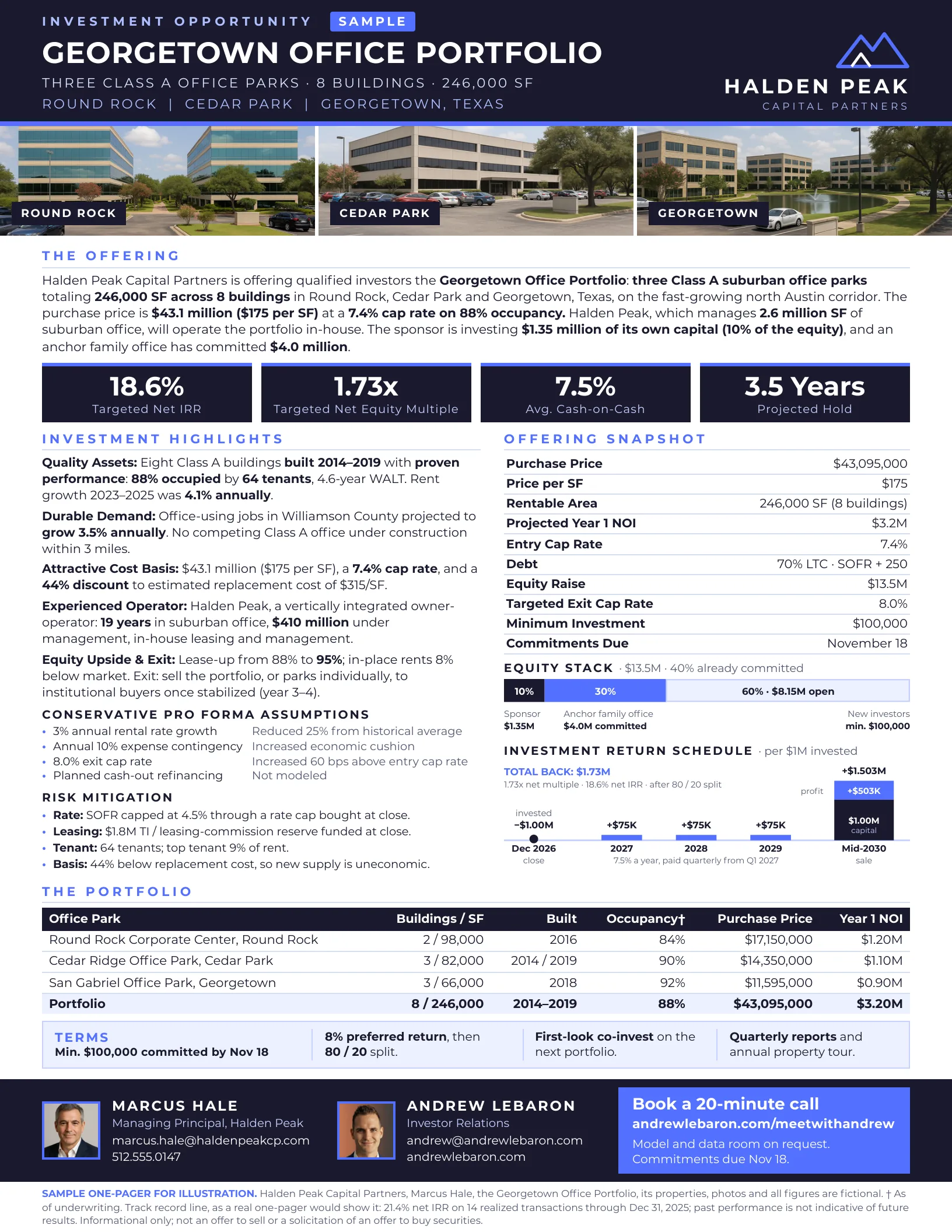
Real photos
Show the actual asset. Stock photos read as a deal that isn't real yet.
Net IRR, not project IRR
Show what the investor keeps after fees and the split.
Proven operator
Who runs the asset, and proof they've done it before.
Upside + exit plan
Where the extra return comes from, and how the deal ends.
Risk mitigation
Name each risk yourself, then show how it's handled.
Terms
Pref, split, minimum and deadline, in one line.
Sponsor's own capital
About 10% of the equity from the sponsor. Skin in the game.
Conservative exit cap
0.5 to 1 point above today's market cap rate.
Anchor investor
Capital already committed, so the next investor isn't first.
When capital comes back
Distributions and the sale, year by year, per $1M invested.
Call to action
One clear next step: book the call.
- 1
Real photos
Show the actual asset. Stock photos read as a deal that isn't real yet.
- 2
Net IRR, not project IRR
Show what the investor keeps after fees and the split.
- 3
Proven operator
Who runs the asset, and proof they've done it before.
- 4
Upside + exit plan
Where the extra return comes from, and how the deal ends.
- 5
Risk mitigation
Name each risk yourself, then show how it's handled.
- 6
Terms
Pref, split, minimum and deadline, in one line.
- 7
Sponsor's own capital
About 10% of the equity from the sponsor. Skin in the game.
- 8
Conservative exit cap
0.5 to 1 point above today's market cap rate.
- 9
Anchor investor
Capital already committed, so the next investor isn't first.
- 10
When capital comes back
Distributions and the sale, year by year, per $1M invested.
- 11
Call to action
One clear next step: book the call.
One-pager questions
What is a one-pager in capital raising?
A one-pager is a single page that summarizes a deal for an investor: the asset, the sponsor, the numbers, the terms and how to take the next step. Its job is to get you a call, not to close the investment.
What do family offices look for in a one-pager?
They screen for a proven operator, the sponsor's own capital in the deal, an anchor investor, real photos of the asset, net returns, a conservative exit, when capital comes back, how risk is handled, and a clear call to action.
Should a one-pager show net IRR or project-level IRR?
Net IRR. It's what the investor keeps after fees and the sponsor's split. Project-level IRR overstates the investor's return, and experienced allocators notice.
What exit cap rate should a one-pager assume?
Use an exit cap rate 0.5 to 1 point above today's market for the asset. A conservative exit keeps the projected returns credible.
Get the sample one-pager
The PDF from the walkthrough above, ready to use as a model for your next raise.
All the data contained within this website is as of 2026 unless otherwise noted. The material on this website is intended for informational purposes only, does not constitute investment advice or analysis, or a recommendation, or an offer of solicitation, and is not the basis for any contract or other agreement to make any investment, or for Andrew LeBaron, LeBaron Capital Partners, LLC, or any of their affiliated entities to enter into or arrange any type of transaction. Nothing on this website should be construed as a guarantee of any particular outcome or result.
Past Performance: Any performance data or comments expressed on this website are an indication of past performance. Past performance is not indicative of future results, and no representation is being made that any investment will or is likely to achieve profits or losses similar to those achieved in the past, or that significant losses will be avoided. All investments carry risk, including the potential loss of principal.
Forward-Looking Statements: The contents of this website may contain forward-looking statements that are based on management's beliefs, assumptions, current expectations, estimates, and projections about the real estate industry, the financial industry, the economy, Andrew LeBaron, LeBaron Capital Partners, LLC, and their affiliated entities and investments. These statements are not guarantees of future performance and involve certain risks, uncertainties and assumptions that are difficult to predict with regard to timing, extent, likelihood and degree of occurrence. Therefore, actual results and outcomes may materially differ from what may be expressed or forecasted in such forward-looking statements. Furthermore, Andrew LeBaron and LeBaron Capital Partners, LLC undertake no obligation to update, amend or clarify forward-looking statements, whether as a result of new information, future events or otherwise.
No Professional Advice: The information provided on this website does not constitute legal, tax, accounting, or other professional advice. You should consult your own professional advisors before making any investment decisions. Andrew LeBaron and LeBaron Capital Partners, LLC are not registered investment advisors, broker-dealers, or financial planners.